Why Poetry Was More Dangerous Than Sex at Court

At the Heian court, intimacy was expected to pass quietly, almost invisibly, through the night, while language was expected to endure. This difference mattered more than any formal rule about propriety.
Physical encounters, when conducted with discretion, could be contained within darkness, timing, and a limited circle of witnesses. Poetry, by contrast, was never contained. It traveled. It accumulated listeners. It detached itself from the moment that produced it and took on a life of its own.
Courtship unfolded through verse not because poetry was ornamental, but because it was dangerous. A poem announced education, taste, emotional intelligence, and social fluency all at once. It also revealed far more than its author could fully control. Tone mattered as much as content. A single line could suggest eagerness, presumption, bitterness, or emotional excess. An allusion could place the writer in a moral or erotic position they had not intended to claim. Even restraint could be read as coldness or disdain. Once a poem left its author’s hand, it became public property in the most precarious sense.
This was a world in which reputation was built not on acts but on traces. A sexual encounter, if it ended correctly—at the proper hour, with the proper withdrawal—might leave no mark at all. A poem, however, left evidence. It could be repeated by servants, quoted inaccurately by rivals, or recalled selectively by those with something to gain. It might be admired one day and weaponized the next. Its meaning was never stable, because meaning depended on who heard it, when, and with what prior assumptions already in place.
Heian women understood this acutely. Their diaries are filled with unease not about desire itself, but about how desire was perceived once it entered language. Sei Shōnagon’s sharp judgments of poetry are not mere aesthetic games; they are assessments of social survival. Murasaki Shikibu’s guardedness about speech reflects a deep awareness that words, once circulated, could never be recalled or corrected. Izumi Shikibu’s terror often lies less in loving than in waiting—waiting to see how a poem will be answered, or how that answer will be read by others.
What makes poetry especially dangerous is that it collapses intention and interpretation into the same fragile space. A poem written in earnest may be received as manipulative. A playful exchange may be read as commitment. A momentary feeling, preserved in verse, may be mistaken for a permanent stance. The writer’s interior state becomes irrelevant once the poem begins to circulate, because circulation replaces intention as the source of meaning.
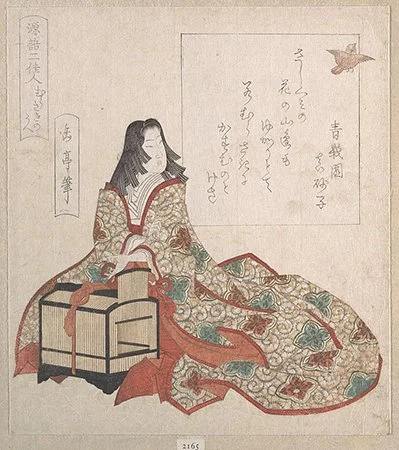
For women, whose intelligence and emotional expression were already subject to suspicion, this instability was lethal. A poem could confirm anxieties others already held: that a woman was too forward, too clever, too desirous, too pleased with herself. Even brilliance carried risk. To write well was to be seen, and to be seen was to invite judgment from those who bore none of the consequences.
Sex, by comparison, operated within conventions that everyone understood. Visits followed expected rhythms. Leaving at the correct hour mattered more than what had occurred before. Silence could protect. Forgetting was possible. Sex belonged to the body and the moment; poetry belonged to memory and to the social world.
This is why poetry, not sex, was the greater threat. Sex ended. Poetry lingered. Sex could be denied, concealed, or reinterpreted. A poem, once remembered, could not. It preserved feeling long after feeling had changed, and in doing so it fixed people into positions they might no longer occupy—or might never have intended to occupy at all.
At the Heian court, the greatest danger was not desire, but legibility. To be misunderstood was to lose control over one’s social meaning, and poetry was the most efficient way to be misunderstood. It asked to be read, repeated, and judged, and it offered no reliable way to manage what would happen next.
This is why Heian writers feared words more than touch. Language endured, and endurance was where harm took root.
