Sei Shōnagon and the Pleasure of the World
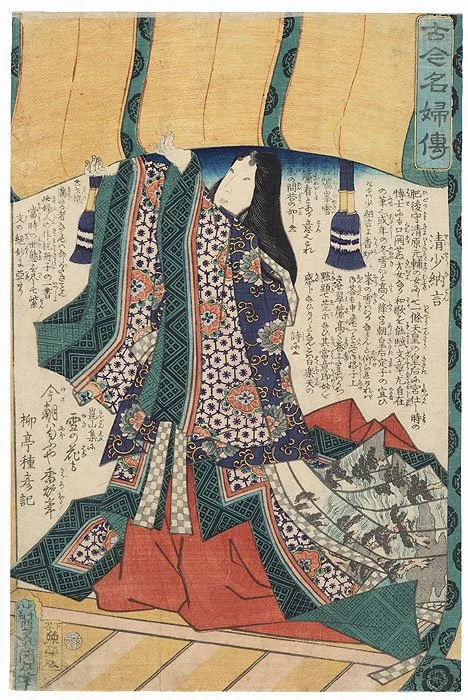
Sei Shōnagon writes as if the world were close enough to touch. Not in the abstract, moralized way of later literature, but in the intimate register of silk against skin, of light caught at a particular angle, of a voice heard through a screen just late enough in the evening to carry promise. The Pillow Book is not a story so much as a state of attention—a record of how it feels to be alive in a body that knows beauty, irritation, desire, and delight.
Shōnagon served Empress Teishi at the height of Heian court culture, a world governed by concealment and display. Women were hidden behind blinds, visible only through layers of fabric, reputation, and voice. Desire moved indirectly: through poetry exchanged at dawn, through the choice of robe colors, through timing rather than touch. In this environment, sensuality was not erased; it was refined.
The Pillow Book preserves this refinement with remarkable precision.
Ivan Morris once described Shōnagon as possessing an “exquisite sensibility to the pleasures of the moment,” and it is this sensibility that animates the text. Her lists—Things That Make One’s Heart Beat Faster, Elegant Things, Things That Lose Their Charm—are not intellectual exercises. They are bodily responses. The quickening heart is literal. The loss of charm is felt, not argued.
Shōnagon understands attraction as situational. A man is appealing not because of moral worth, but because he knows when to leave, because his handwriting suits the poem, because his voice carries correctly through the dark. Erotic charge, in her world, lies in timing and restraint. What excites is not possession but attunement.
This sensibility becomes especially clear in one of The Pillow Book’s sharpest and most revealing sections: “Hateful Things.”
A man who, having stayed the night, lingers far too long after dawn.
Someone who speaks as though he understands, when he plainly does not.
A lover who sends a poem at the wrong moment.
People who press too close when distance would be more elegant.
What is striking here is not cruelty, but erotic exactitude. These are not abstract irritations; they are violations of rhythm. The hatefulness lies in misattunement—in failing to read the body, the hour, the mood. A man who overstays after intimacy does not merely annoy; he collapses desire by refusing to let it end correctly.
Sexuality, for Shōnagon, depends on endings as much as beginnings.
This is where The Pillow Book diverges sharply from the work of Murasaki Shikibu.
Murasaki’s writing bends toward interiority and consequence. Desire in The Tale of Genji is heavy with aftermath—jealousy, grief, religious unease. Sexuality unfolds within a moral landscape shaped by impermanence and loss. Love affairs ripple outward, damaging women, destabilizing households, lingering long after the initial encounter. Shōnagon does not linger in this way. She records pleasure before it curdles into regret. Her attention stops at the moment when something delights or disappoints. She does not deny impermanence; she simply refuses to let it dominate the frame.
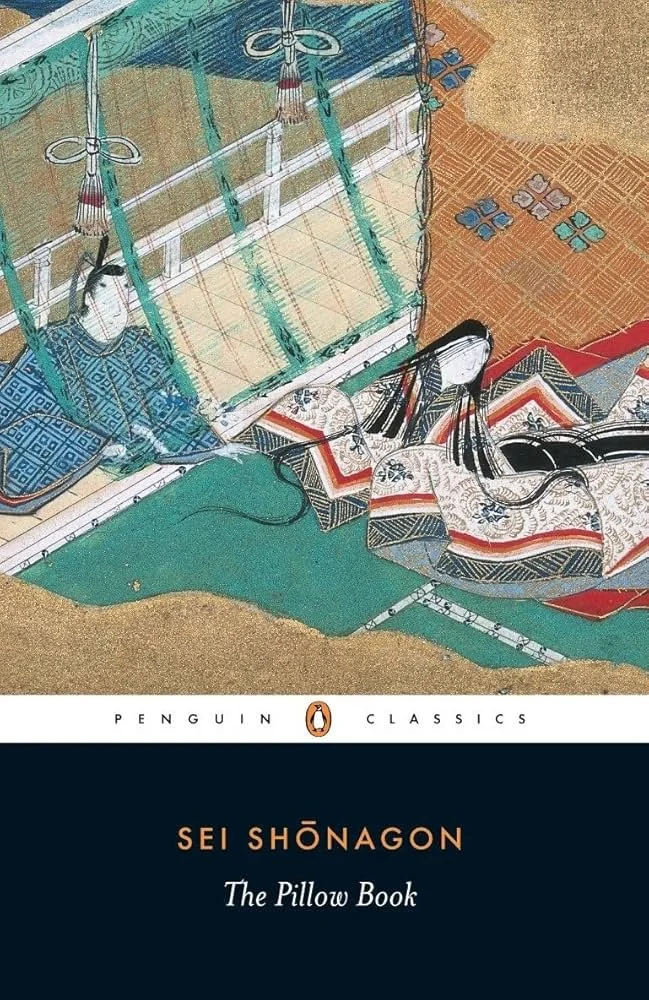
Meredith McKinney has observed that The Pillow Book is often mistaken for casual writing, when in fact it is governed by an uncompromising aesthetic discipline. The lists teach the reader how to feel correctly, how to register pleasure and revulsion with precision. Taste, in this world, is not decorative—it is social intelligence.
Sexuality in The Pillow Book is rarely explicit, but it is everywhere present. It resides in anticipation, in disappointment, in the embarrassment of a poorly chosen poem. It appears in Shōnagon’s irritation with men who misunderstand tone, who fail to withdraw, who do not know when desire has already peaked. Erotic pleasure here is fragile. It depends on mutual perception.
This distinguishes Shōnagon not only from Murasaki, but from Izumi Shikibu as well.
Izumi writes from inside desire as ordeal. Her diary pulses with longing, abandonment, religious fear, and erotic intensity that borders on pain. Love consumes her; Buddhism presses in as both refuge and rebuke. Sexuality transforms, wounds, overwhelms.
Shōnagon’s pleasures are lighter, but no less exacting. She does not burn; she gleams. Where Izumi confesses, Shōnagon judges. Where Izumi endures, Shōnagon notices—and moves on.
This tonal difference has often been mistaken for shallowness.
Yet The Pillow Book offers something rare: a woman’s erotic authority exercised without apology and without appeal. Shōnagon does not pause to justify her desire, to situate it within virtue or suffering, or to frame it as either cautionary or redemptive. She does not translate pleasure into moral lesson, nor does she soften irritation into humility. Desire, in her writing, requires no defense. It stands on the authority of perception itself.
This refusal is radical. Shōnagon neither confesses nor conceals. She does not ask the reader’s forgiveness, nor does she seek their admiration. Instead, she assumes a shared understanding—that the reader will recognize why a certain voice pleases, why a moment collapses when prolonged, why an ill-timed gesture dissolves attraction entirely. Her writing presumes a reader capable of discernment. To read her well is already to belong.
That presumption carries risk. Shōnagon’s wit, her sharpness, her sensual intelligence depend on proximity: to power, to taste, to a court culture whose codes were legible only to those initiated into its rhythms. Her judgments make sense within a world that valued timing over intensity, elegance over confession, suggestion over excess. When that world began to fracture—when Empress Teishi died, when her household fell from favor—the social ground beneath Shōnagon’s voice shifted.
What had once been shared knowledge became vulnerable to misreading.
The text itself seems dimly aware of this danger. Beneath the sparkle runs a faint current of defensiveness, an anxiety about circulation: who will read this, and how. Delight, once written down, risks being stripped of context. Precision can look like cruelty. Discernment can be mistaken for arrogance. Sensual authority, removed from its cultural matrix, can be recast as frivolity or malice.
Yet Shōnagon does not revise herself to forestall this. She does not temper her judgments or explain her standards. She leaves the writing as it is, trusting—perhaps stubbornly—that those who possess the necessary sensibility will recognize it, and those who do not will never have been the audience in the first place.
In this way, The Pillow Book becomes more than a record of court life. It is a wager: that attention, finely trained, is enough; that pleasure, accurately perceived, carries its own legitimacy; that a woman’s authority over her own responses does not require narrative framing to be real.
The risk is that such writing may be misunderstood.
The reward is that, when it is understood, it remains unmistakable
What The Pillow Book offers is not moral instruction, but permission: to attend closely, to judge sharply, to enjoy without justification, to feel one’s heart quicken and not translate that sensation into lesson or penitence. Sei Shōnagon reminds us that sensuality does not require confession, that sexuality does not require narrative resolution. Sometimes it exists simply as attention sharpened into pleasure.
And that, she insists—without apology—is enough.
