Same-Sex Desire and Rank in Heian Japan
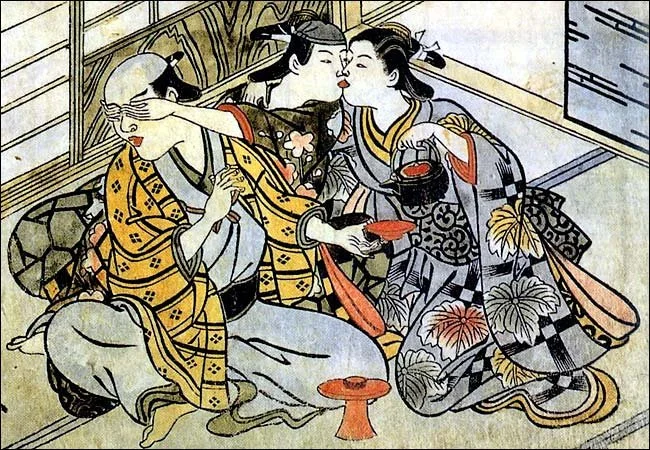
People often imagine desire as something private, interior, almost defiant—a force that pushes against the structures meant to contain it. But in the eleventh century, desire did not live in opposition to the social order. It moved through it. It learned its contours early. It survived by knowing exactly where it stood.
This is the first thing modern readers often miss when they go looking for homosexuality in Heian Japan. The question itself assumes too much: that desire announces itself clearly, that it seeks recognition, that it demands explanation. The court expected none of this. What mattered was not who one desired, but how that desire aligned—or failed to align—with one’s place in the intricate lattice of lineage, office, household, and favor that governed every interaction.
Heian society was built on proximity. Aristocrats lived pressed together in overlapping compounds, separated by screens rather than walls, attuned to the sound of footsteps, the rustle of silk, the smell of incense drifting from neighboring rooms. Privacy, as we understand it, scarcely existed. Yet this closeness did not produce frankness. It produced indirection. Attention had to be calibrated. Affection had to be plausible. Desire survived by learning how to look like something else.
In this world, rank was the grammar through which intimacy became legible. Relationships were intelligible insofar as they respected vertical distinctions: senior and junior, patron and dependent, protector and protected. Desire that flowed downward was easier to absorb into the social fabric. Desire that reached upward was fraught. Desire that crossed too many boundaries at once—rank, household, political faction—was dangerous.
Same-sex desire was not, in itself, a problem. In some contexts, it was less volatile than heterosexual attachment. A senior courtier’s fondness for a younger man could be framed as mentorship, cultivation, or patronage. The ambiguity was useful. It allowed intimacy to exist without forcing it to declare itself. The court did not require desire to be named. It required it to behave.
What could not be tolerated was desire that disrupted hierarchy or exposed dependency too openly. A relationship that made power visible where it should have remained implicit—one that revealed vulnerability, fixation, or emotional imbalance—invited scrutiny. The issue was never gender alone. The issue was always alignment.
The Heian archive reflects this logic with remarkable consistency. Diaries, letters, and poetic exchanges—many written by women positioned as observers rather than actors in official life—rarely describe sexual acts directly. They do not need to. The court knew how to read. A gift sent too often. A poem returned too quickly. A visit that leaves no formal trace but lingers in the tone of subsequent exchanges. Desire appears not as confession, but as consequence.
When Murasaki Shikibu writes about attachments between men, she does not pause to categorize them. She does not name them as transgressive or exceptional. Instead, she attends to atmosphere: whether such relationships appear dignified or excessive, stabilizing or faintly ridiculous. Her judgments are social and aesthetic, not moral in any modern sense. What matters is whether the attachment enhances a man’s standing or subtly undermines it. Does it make him appear refined, loyal, properly placed? Or does it suggest overinvestment, a loss of restraint, a failure to keep feeling in its proper register?
Desire that reinforced rank could pass without comment. Desire that exposed imbalance could not.
From a modern perspective, it can be startling how little emphasis Heian texts place on the gender of the beloved compared to the position the beloved occupies. This does not mean gender was irrelevant. It means it was rarely decisive on its own. Men’s relationships with women were often more socially volatile than relationships with other men, precisely because women were nodes in marriage politics, inheritance, and alliance-building. A misplaced heterosexual attachment could generate rivalries, resentments, or political fallout that rippled outward through families and factions.
Same-sex desire, by contrast, could sometimes be absorbed into existing hierarchies without producing new lines of conflict. As long as discretion was maintained and rank respected, such relationships did not necessarily threaten the reproductive economy of the court or create competing claims. They could remain socially unmarked—not celebrated, but not automatically suspect either.
The court was not interested in sincerity of feeling. It was interested in legibility.
Trouble arose when desire ceased to remain legible within the expected grammar of rank. Excessive attachment, regardless of gender, could provoke unease. A man who appeared emotionally undone by another man risked being seen as unserious, unstable, or improperly oriented toward public life. Emotional sensitivity was admired, even prized—but only when it was properly modulated. To feel deeply was acceptable. To be governed by feeling was not.
The danger, then, was not queerness. It was exposure.
This is why so many traces of same-sex desire in the Heian record remain partial or fleeting. They surface briefly and then vanish, noted without elaboration, absorbed into the background noise of court life. Silence here is not repression in the modern sense. It is strategy. Desire survives by not insisting on itself.
Much of what we know about Heian intimacy comes to us through women’s writing, not because women were freer to speak about sex, but because they occupied a position of constant observation. Excluded from certain forms of action, they became acute readers of social nuance. They recorded what they saw, what they overheard, what disturbed the equilibrium of the court. Yet this also means that female same-sex desire is far harder to trace. Women’s lives were structured around enforced proximity, shared sleeping arrangements, and intense emotional bonds. Touch and affection were ordinary. Distinguishing erotic desire from normative intimacy is often impossible—and the texts rarely attempt to do so.
This absence should not be mistaken for nonexistence. It reflects the same principle that governs the rest of the archive: desire becomes visible only when it becomes socially consequential. Much intimacy never crossed that threshold. Again and again, rank determines what enters the record.
Perhaps the most difficult adjustment for modern readers is accepting that desire did not define the self in Heian Japan. It was not an identity, not a truth waiting to be named. It was something one did, something one navigated, something that took shape in relation to others and could change without demanding narrative coherence. Desire did not need to explain itself. It needed only to be survivable.
This does not make the Heian court a paradise of sexual freedom. It was hierarchical, unforgiving, and relentlessly attentive. But it did allow for forms of same-sex desire to exist without forcing them into the rigid categories that would emerge much later under the influence of modern moral and medical discourse. What was regulated was not orientation, but comportment. Not whom one loved, but how that love appeared within the social field.
When we approach Heian Japan searching for ancestors of modern sexual identities, we risk flattening a far more intricate world. Same-sex desire did not require justification because it did not require naming. It borrowed legitimacy from rank, ritual, and obligation. It survived by understanding its place.
To say that status mattered more than gender is not to deny the reality of desire. It is to recognize that desire was always embedded in power. It moved carefully. It learned when to appear and when to vanish. And in a court where everything was seen and remembered, knowing where one stood was not simply a matter of etiquette. It was the condition of being able to feel at all.
