Male Intimacy at the Heian Court
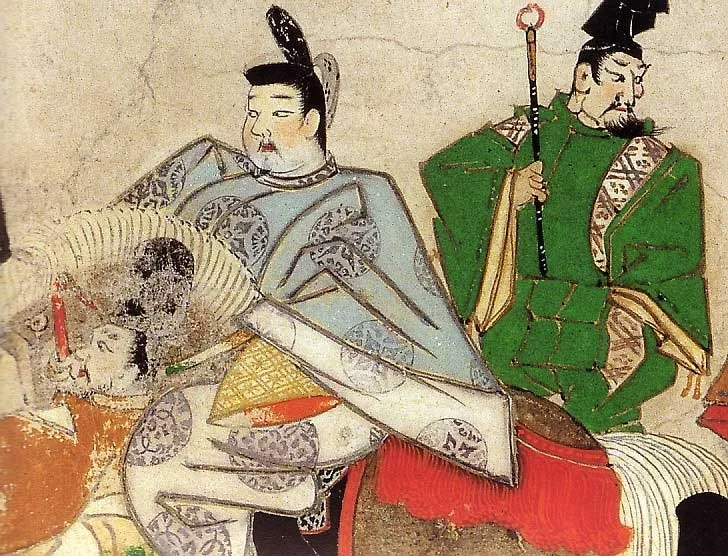
Male intimacy in the Heian court rarely announces itself directly. It appears instead at the edges of things: in poems exchanged too frequently, in nights noted without detail, in relationships mentioned briefly and then passed over. To read these traces as evasions is to misunderstand how court writing functioned. The diaries do not conceal intimacy so much as assume a readership trained to recognize it without explanation. What mattered was not disclosure, but legibility within a shared social grammar.
Court diaries were not confessional texts. They were records of attention. Writers noted what disturbed equilibrium, what drew notice, what altered the emotional weather of a room. Intimacy between men enters the record only when it produces consequence—when attachment becomes visible through excess, imbalance, or reputational risk. When relationships remain socially contained, they are rarely remarked upon at all. Silence, here, signals normalcy rather than denial.
Poetry was one of the primary vehicles through which male intimacy circulated. Verse allowed feeling to move without committing itself fully to action or declaration. A poem could register admiration, longing, or dependence while remaining formally ambiguous. When poems pass back and forth between men with unusual frequency or intensity, the diaries sometimes note the exchange without comment, trusting the reader to understand its significance. The meaning lies not in the content alone, but in the rhythm of response.
Absence is equally telling. Diaries often record a man’s presence in another’s company without specifying what occurred, especially when the interaction fits within acceptable hierarchies of age or rank. A night spent together may be acknowledged only through its aftermath—a change in mood, a hint of distraction, a ripple of gossip. These omissions are not gaps in knowledge. They are part of the system by which intimacy remained survivable.
Writers such as Murasaki Shikibu demonstrate this obliqueness with precision. When she remarks on relationships between men, she does so through tone rather than categorization, noting whether an attachment appears dignified, excessive, stabilizing, or faintly absurd. Her concern is social coherence, not sexual classification. The question is never what kind of desire this is, but whether it fits.
Similarly, Sei Shōnagon records male relationships through moments of irritation, amusement, or aesthetic judgment. She is attentive to who lingers, who oversteps, who becomes emotionally exposed. Intimacy is visible when it disrupts composure or draws attention in ways that cannot be fully smoothed over. What remains discreet does not require narration.
Euphemism plays a crucial role in this economy of suggestion. Terms associated with companionship, mentorship, or attachment carry layers of meaning that do not need unpacking. A relationship can be named without being defined. The ambiguity protects all involved, allowing intimacy to exist without demanding explanation or moral reckoning. The diaries rely on shared cultural knowledge rather than explicit description.
What emerges from these texts is not a hidden history waiting to be uncovered, but a different way of organizing visibility. Male intimacy was neither exceptional nor uniformly marked. It became legible only when it pressed against the limits of rank, discretion, or emotional restraint. Desire that remained properly placed could pass without comment. Desire that threatened to unbalance the social field entered the record obliquely, through hints and aftermaths.
Reading Heian diaries for male intimacy requires a shift in expectation. We must learn to read sideways rather than straight on, to attend to pacing rather than proclamation. What these texts offer is not proof in the modern sense, but recognition—an invitation to see how intimacy functioned within a world that did not require it to be named in order to be real.
In the Heian court, what was most intimate was often what could be left unsaid.
