Why “Homosexuality” Is the Wrong Word (and Why We Still Use It)
The word homosexuality arrives late to history. It belongs not to the worlds most historians of pre-modern societies study, but to the nineteenth century, when European medical, legal, and psychological discourses began to classify sexual behavior as evidence of interior identity. To apply this term to earlier periods is therefore, strictly speaking, an anachronism.
Pre-modern societies did not organize desire around sexual orientation, nor did they assume that erotic acts revealed a stable category of personhood. And yet, despite this mismatch, the term continues to appear in scholarship on earlier cultures. The question is not simply whether the word is inaccurate, but why it persists—and what work it is being asked to do.
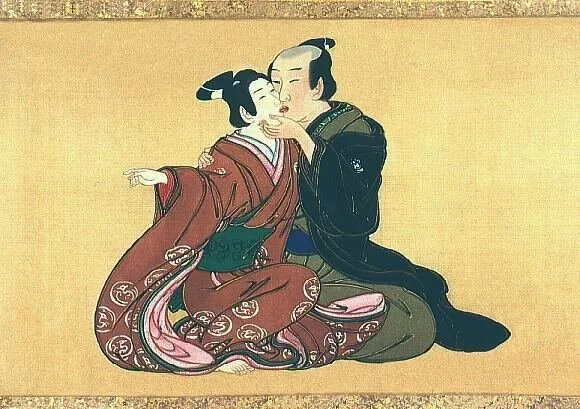
In pre-modern Japan, as in many other societies, erotic behavior was understood relationally rather than identitarily. Desire was structured through age, rank, status, and role, not through an abstract distinction between heterosexual and homosexual subjects. A man’s intimacy with another man did not mark him as a different kind of person; it marked him as someone participating in a particular relationship, governed by specific social expectations. Acts mattered, but they did not aggregate into a sexual self. To describe such relationships as “homosexual” risks importing assumptions about identity, psychology, and self-recognition that simply did not exist.
Translation compounds this problem. Modern sexual terms carry conceptual weight that exceeds their literal meaning. When scholars translate pre-modern references to same-sex intimacy using words like homosexuality, they inevitably introduce frameworks shaped by modern Western sexology. These frameworks assume binaries, fixed orientations, and interior truths that historical actors neither articulated nor recognized. The result is not just imprecision, but distortion. The past begins to look like a precursor to the present rather than a fundamentally different way of organizing human experience.
At the same time, refusing the term altogether creates its own problems. To avoid homosexuality entirely can produce prose so cautious that it becomes unreadable or so euphemistic that it obscures its subject. More importantly, it risks erasing the very histories scholars seek to recover. Same-sex desire did exist. Erotic relationships between people of the same sex were lived, narrated, regulated, and remembered. To speak around them endlessly without naming them can replicate a different kind of silence—one that mirrors historical marginalization rather than critically examining it.
This tension explains why scholars often continue to use homosexuality while surrounding it with caveats. The term becomes a compromise rather than a claim. It functions as a bridge between modern readers and historical material, signaling that the subject under discussion concerns same-sex erotic relations without insisting that those relations operated according to modern categories. Used carefully, the word points toward a field of inquiry rather than a fixed definition. It names a problem space, not an identity.
Scholarly practice, after all, is not only about accuracy; it is also about legibility. Historians write for audiences shaped by contemporary language, politics, and educational frameworks. To eliminate familiar terms entirely can render research inaccessible, especially outside narrow academic circles. The continued use of homosexuality reflects a pragmatic recognition that scholarship exists within language systems it did not choose. Precision sometimes requires explanation rather than replacement.
Yet this pragmatic use carries ethical responsibility. Every time the term appears, it should be accompanied—explicitly or implicitly—by an awareness of its limits. Scholars must resist the temptation to let the word do explanatory work it cannot support. Homosexuality should not be treated as a timeless phenomenon waiting to be discovered in earlier periods. It should be treated as a modern label applied retrospectively, with all the distortions that such application entails.
This is why many historians prefer phrases such as “same-sex desire,” “male-male intimacy,” or “erotic relations between men.” These formulations shift emphasis away from identity and toward practice, affect, and social context. They allow scholars to describe what people did and felt without assuming how they understood themselves. Such language does not solve the problem of anachronism, but it mitigates it by keeping interpretation open rather than closed.
Still, even these alternatives are not neutral. “Same-sex” presumes a binary understanding of sex that may not align neatly with historical concepts of gender. “Desire” foregrounds interiority in ways that may exceed the evidence. Every term brings its own baggage. The task, then, is not to find a perfect word, but to remain critically attentive to the words we choose and the histories they carry with them.
The persistence of homosexuality in historical writing ultimately reflects a broader challenge in the humanities: how to speak across conceptual worlds without collapsing one into the other. Scholars must balance fidelity to the past with responsibility to the present. Complete linguistic purity is impossible; so is complete transparency. What matters is reflexivity—the willingness to explain why a term is used, what it can and cannot capture, and where it risks misleading.
In this sense, using homosexuality is less an error than a negotiation. It acknowledges that modern readers need orientation even as it refuses to pretend that the past was organized like the present. The word becomes a starting point rather than a conclusion. It opens inquiry rather than resolving it.
To say that homosexuality is the wrong word is not to say it should never be used. It is to insist that its use be deliberate, contextualized, and uneasy. The discomfort it produces can be productive if it prompts readers to question their assumptions about sexuality, identity, and historical continuity. When handled carefully, the term can illuminate the distance between past and present rather than obscuring it.
Ultimately, the goal of historical scholarship is not to retrofit modern categories onto earlier worlds, nor to retreat into antiquarian silence. It is to make difference intelligible without erasing it. The ongoing debate over homosexuality as a historical term reminds us that language is not merely descriptive. It is interpretive. And interpretation, like history itself, is always a matter of careful compromise.
