Episode III: The Quiet Shore
In later years, I would come to understand that removal from the court did not resemble exile as one imagines it in stories. There were no raised voices, no dramatic farewells. One was not cast out so much as gently set aside, like an object too delicate—or too dangerous—to remain in daily use.
Izumi departed at dawn.
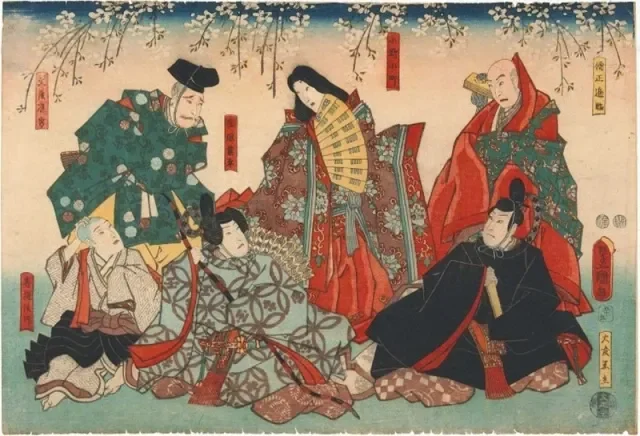
The timing itself was merciful. At that hour, the corridors were thinly populated, and the court still half-asleep. Servants moved quietly, careful not to look directly at her, though they knew her well enough. Her belongings had been reduced to what could be carried discreetly: writing implements, robes appropriate to reduced visibility, a lacquered box containing poems she did not trust to memory alone.
I watched from behind a screen, as was proper. To witness openly would have invited interpretation, and interpretation was no longer safe. Izumi moved with the same assurance she had always possessed, but something in her step had changed—not weakened, but steadied, as if she had already crossed a threshold the rest of us could only approach in imagination.
Sei Shōnagon did not attend the departure. Later, she would claim she had been indisposed, though I suspected she understood better than any of us that absence, in such moments, could be its own form of loyalty. She would remember Izumi perfectly. That, for Sei Shōnagon, was the greater gift.
The carriage waited beyond the inner gates, plain and unadorned. Izumi did not look back as she entered it. When the curtains fell, it was as though a space in the palace had quietly sealed itself.
Only then did I realize how accustomed I had become to her presence—to the way she unsettled rooms merely by entering them, how desire seemed to organize itself around her, like water finding a slope. Without her, the court felt flatter, quieter, as though one dimension had been pressed closed.
In the days that followed, no one spoke her name.
This was the most telling sign of all. Izumi had not been condemned. She had been misplaced. Her absence was treated as a matter of timing rather than consequence, and this fiction was carefully maintained.
I continued my duties as before. I wrote when asked. I observed always. Yet I learned quickly that there were now things I was expected not to see. Certain exchanges were conducted behind newly positioned screens. Certain poems never reached my hands. Silence, I discovered, could be taught.
The empress was kind to me during this period, though her kindness took the form of distance. She asked no questions about Izumi. She praised my restraint. Once, when I hesitated before offering an observation, she inclined her head and said, “Not all insight must arrive at once.”
I understood then that patience had become my assigned virtue.
In the evenings, when the lamps burned low and the court’s breath slowed, I found myself thinking of Izumi not as she had been among us—laughing, brilliant, perilous—but as she must now be: seated somewhere unfamiliar, listening to different silences, learning the texture of a quieter world. I wondered whether desire diminished when unobserved, or whether it sharpened in the absence of constraint.
A letter arrived near the end of the month.
It bore no seal of rank, only careful handwriting I would have recognized anywhere. It spoke of weather, of the view from a borrowed veranda, of how the sound of water differed beyond the capital. Nothing improper was written. Nothing that could be accused.
And yet, folded within the letter was a poem:
Far from the gate,
the moon still finds my sleeve—
distance does not dim.
I did not reply at once.
I read the poem several times, committing it to memory before hiding the letter among less dangerous papers. I understood now what the court had always known: writing creates paths. Once followed, they are difficult to abandon.
Sei Shōnagon visited me that evening. She spoke of trivialities—of a poorly chosen robe, of a courtier whose manners had deteriorated noticeably. Only as she rose to leave did she say, lightly, “Absence rearranges value, does it not?”
I answered carefully. “It clarifies it.”
She smiled. “Then remember what is being clarified.”
That night, I returned to my writing surface and prepared a page I did not intend to submit. I wrote slowly, without ornament, recording not events but conditions: how silence thickened, how attention narrowed, how women learned to make themselves legible only in fragments.
I did not write Izumi’s name.
I did not need to.
Looking back, I see that this was the moment when my work changed. Before, I had written as one within the court, attentive to its rhythms and rewards. After Izumi’s departure, I began to write as one who understood that even the most beautiful structures are maintained through erasure.
The court endured, as it always does. Poems continued to circulate. Alliances shifted. New figures rose into notice. But something irretrievable had been lost—not brilliance, not desire, but the illusion that either could exist without consequence.
As for Izumi, she remained present in the only way that truly mattered.
She lived on in memory.
And memory, I had learned, was the most dangerous form of permanence the court had ever known.
