Episode I: The Garden of Shadows
Morning arrived without announcement, filtering itself through layers of silk, wood, and habit. Light slid through the lattice screens in careful squares, touching lacquered floors where servants had already passed, knees whispering, sleeves tucked, eyes lowered. The air carried sandalwood from the night braziers, camellia oil worked into hair, and the faint sweetness of wisteria drifting inward from the garden beyond the screens. Somewhere, water moved—slow, deliberate, as if aware it was being overheard.
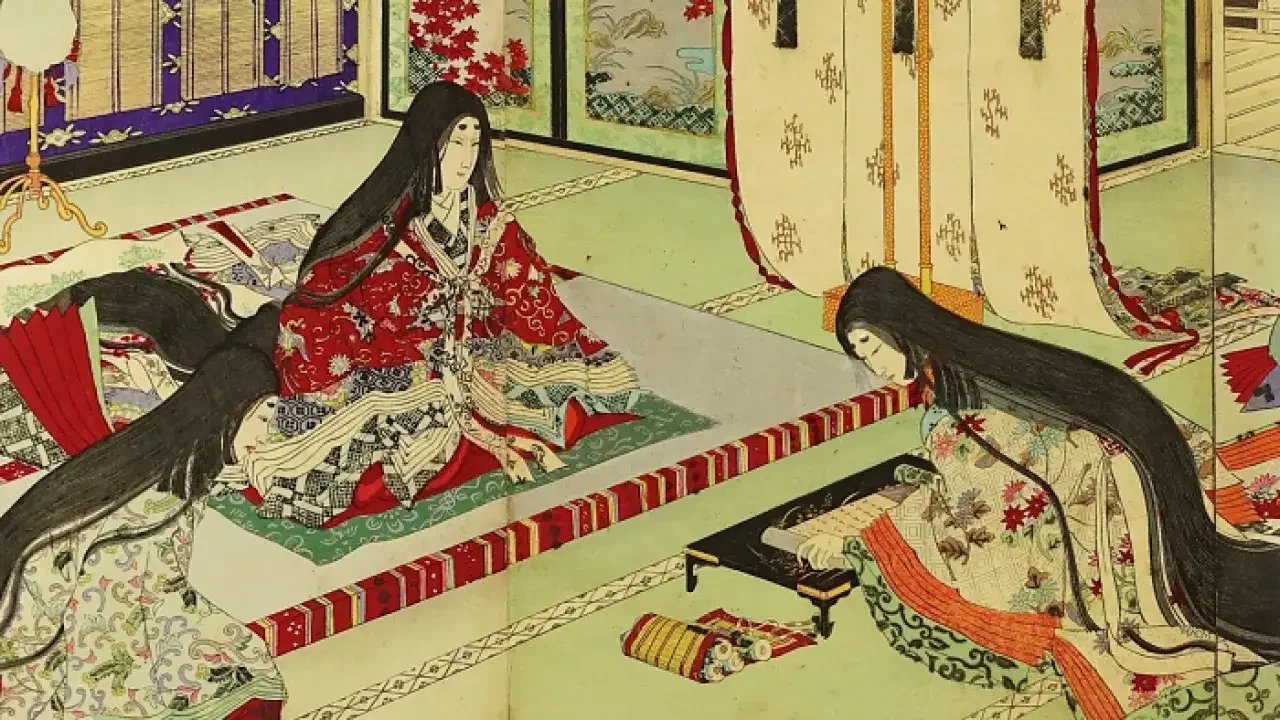
The hall faced east, its orientation itself a declaration. Nothing here was accidental. Screens shifted the body’s knowledge of space; raised thresholds trained the feet; even silence was choreographed, falling heavier in some corners than others.
Murasaki knelt near the east-facing alcove, where the light was best and the drafts most treacherous. Violet robes layered over pale lavender silk settled around her like a controlled spill. Her writing surface was immaculate: paper trimmed just so, ink ground to the proper density, brush balanced between motion and restraint. Yet she did not write.
Instead, she watched.
A court lady’s hand shook as tea was poured—only once, quickly corrected. A bow dipped a fraction too low, signaling either deference or calculation. A glance moved sideways, then down, then still. These were not accidents. They were disclosures. The court spoke constantly, if one knew how to listen.
Across the hall, Izumi occupied space differently. She leaned against an embroidered screen depicting cranes lifting into mist, her posture loose enough to suggest disregard, precise enough to remain permissible. Crimson and gold sleeves caught the light each time she moved, announcing her presence without asking leave.
Prince Atsumichi wandered the garden paths beyond the screens, among moss-dark stones and carefully trained pines. His movements were unhurried, ornamental—meant to be observed. Izumi’s gaze followed him openly. Her smile did not soften; it sharpened. It dared him to notice. It dared the court to object.
Sei Shōnagon reclined nearby, fan half-open in her hand, green silk embroidered with autumn leaves edged in gold thread. She laughed softly—once—then stopped. The sound cut the air cleanly. She catalogued everything: whose sleeve brushed the mat, whose silence stretched too long, whose taste revealed too much hunger. Memory was her chosen weapon, and she kept it honed.
When the empress entered, the temperature of the room changed.
Her layered silks—deep blue over pale gold—signaled both authority and restraint. Pine resin and incense trailed her like a private weather. She paused just inside the threshold, letting the room realign itself around her, then inclined her head slightly. Only then did the others breathe again.
“Today,” she said, her voice low and deliberate, “we will test the weight of words.”
No one moved.
“Let them reveal,” she continued, “what the heart dares not speak.”
Izumi’s laugh came lightly. “And which voice does the heart obey?” she asked. “The one who whispers—or the one who watches?”
Sei Shōnagon snapped her fan open, then closed it again. “A glance can be trained into a blade,” she said. “A smile into a snare.”
Murasaki finally lowered her brush into ink. “Desire passes,” she said quietly. “The record does not.”
The empress’s eyes flickered—approval, or warning.
By midmorning, the garden breathed more freely. Silk rustled. Sachets heavy with crushed blossoms passed from hand to sleeve. The sun climbed, and with it, attentions sharpened.
Atsumichi lingered near a stone lantern positioned to suggest accident but designed for visibility. He adjusted his sleeve—too late. Izumi had already marked it. She leaned forward, voice low, and let a poem drift as if unintentional:
Red blossoms fall—
my heart leaps, uncontained;
no wall holds desire.
The words traveled faster than the sound of water.
Sei Shōnagon watched the prince’s reaction with practiced delight. “Suggestion,” she murmured, tapping her fan against the mat, “requires only the appearance of chance.”
Murasaki’s brush moved at last:
Morning mist lifts—
a prince’s shadow pauses,
quietly redirecting paths.
The empress smiled—not warmly, but with recognition. “Daring and restraint,” she said. “Charm and patience. Separately, they amuse. Together, they rule.”
Izumi’s sleeves brushed the floor as she leaned closer. “Observation can linger too long,” she said. “The heart grows restless.”
Sei Shōnagon’s mouth curved. “Or reveals itself under pressure.”
Murasaki said nothing. Her attention rested on Atsumichi, steady, unblinking. She knew this truth well: to observe was already to intervene.
By afternoon, whispers layered over one another like gauze. A minor prince arrived bearing a scroll, his hands careful, his posture rehearsed. Shōshi accepted it, passing it to Izumi.
Izumi read aloud—playful, exact. The verse praised beauty, lamented distance, and buried within its turns a warning aimed at a rival faction. Only those trained to hear would hear it.
Sei Shōnagon leaned in. “Challenge disguised as devotion,” she said. “A test of intelligence, not affection.”
Murasaki continued writing. “The court scripts all of us,” she said softly. “Every gesture is already part of a larger hand.”
Izumi met the prince’s gaze. “Some currents refuse diagrams,” she said. “They must be entered.”
Evening closed the screens. Candlelight softened edges, warmed lacquer, caught gold thread in robes now loosened with the day. The empress withdrew, and with her went the formal tension, leaving something quieter—and more dangerous—behind.
The fountain whispered on.
“Love resists discipline,” Izumi said at last. “My poems invite as much as they confess.”
Murasaki sipped her tea. “Without perception, desire collapses into noise.”
Sei Shōnagon tapped her fan once. “Wit survives what passion exhausts. Memory is its blade.”
They exchanged their final verses:
Murasaki:
Twilight deepens—
even the tallest pine bends;
hearts follow.
Izumi:
Crimson petals fall,
urgent, unbound—
night answers longing.
Sei Shōnagon:
A glance recalled,
a misstep kept bright—
power hides there.
Candles guttered low. The court exhaled. Beneath the quiet, forces continued to move—desire, judgment, record, strategy. And it was unmistakable: true power did not sit on thrones or issue decrees. It moved invisibly, carried in words, glances, and what was chosen—carefully—to be remembered.
